How I verified, claim by claim, that a project was exactly what it said it was: the Inflables Publicitarios case
After finding several real problems in this series, what does a project look like where the documentation actually matches production?
By Pietro Fiorillo ·
In this article
Why I'm closing this series with a case that confirms what's documented
Across this series I found published pages describing nonexistent features, prerendering that had stopped working, and even HTML with content crossed between pages. If I only showed those cases, I'd be giving a skewed picture of my own work. This closing piece verifies, with the same method, a project where the documentation actually holds up.
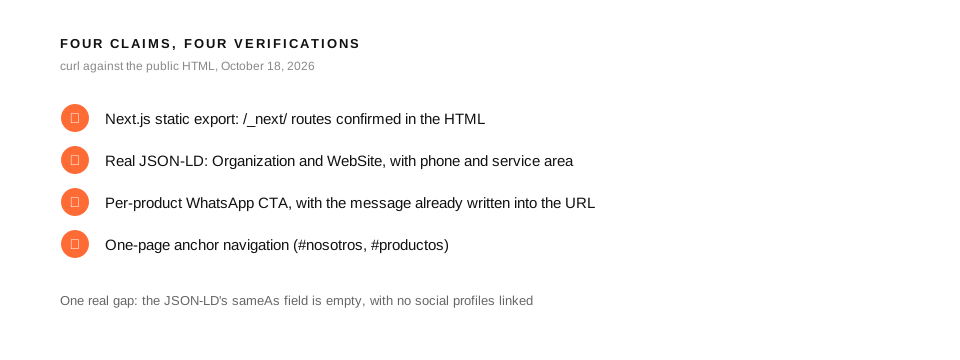
Claim 1: a real Next.js static export
The public HTML includes /_next/ routes and the JavaScript loading pattern typical of a Next.js static export. There's no sign of a dynamic server behind it.
Claim 2: real structured data, with one concrete gap
The site serves a real <script type="application/ld+json"> block, with Organization and WebSite connected, phone number and service area included.
{
  "@context": "https://schema.org",
  "@graph": [
    {
      "@type": "Organization",
      "name": "Inflables Publicitarios",
      "areaServed": "Argentina",
      "telephone": "+549...",
      "sameAs": []
    },
    {
      "@type": "WebSite",
      "name": "Inflables Publicitarios",
      "inLanguage": "es-AR"
    }
  ]
}The sameAs field, meant to link social profiles or other directories where the same entity appears, is empty. It's not an error that breaks anything, but it's a real, unused opportunity to reinforce the entity.
Claim 3: a different WhatsApp CTA per product line
Each product line builds a WhatsApp link with a message already written, specific to that line.
https://wa.me/549.../?text=Hola%2C%20quiero%20consultar%20por%3A%20Stands%20inflables.Claim 4: a single page, navigated by anchors
The site's navigation uses internal links (#nosotros, #productos) instead of separate routes, consistent with a single-page landing designed to take visitors from the catalog to WhatsApp in a few clicks.
Measurable results
| Metric | Result | Environment / evidence |
|---|---|---|
| Lighthouse Performance (mobile, lab) | 90 / 100 | Lighthouse 13.5.0, simulated throttling |
| LCP (lab) | 3.6 s | Same Lighthouse run, not field (CrUX) data |
| URLs in the sitemap | 1 | Consistent with a single-page site |
| Documented claims verified | 4 of 4 | Static export, JSON-LD, per-product WhatsApp, anchor navigation |
An audit that only finds problems isn't more rigorous, it's just incomplete in the other direction.
My part in this project
My part in Inflables Publicitarios included building the site and its technical SEO, as part of my work at MANYA Digital.
What I'd do differently: an empty field that's easy to fill in
The one real loose end I found is the empty sameAs field in the JSON-LD. It's a low-effort, no-risk improvement: adding the company's real social profiles, if they exist, strengthens the entity without touching anything else on the site.
What I'd test next
I'd fill in the sameAs field with the company's real profiles and evaluate whether adding Product-type structured data per factory line (instead of only site-level Organization and WebSite) helps each product get understood better by search engines and AI systems.
Sources
Frequently asked questions
Why is the site a single page instead of several?
Because the goal is for visitors to go from the catalog to WhatsApp in two clicks. For a factory with 10 product lines and a sales process that resolves through a direct inquiry, a landing page with anchor navigation reduces friction better than a multi-page architecture.
What does an empty sameAs field mean?
That the Organization structured data doesn't link to any social profile or external directory. It doesn't break anything, but it's a missed opportunity to connect the entity to other brand mentions across the web.
How did you verify this with no repository access?
I requested the public HTML with curl and read the JSON-LD block, the WhatsApp links and the Next.js routes directly in the served source code. I didn't need the repository to confirm every documented claim was real.
Why does each WhatsApp button have a different pre-filled message?
Because it automatically builds a product-specific message («I'd like to ask about: Inflatable stands»), so the sales team knows upfront what the person is interested in without them having to type it.
Is the site really static?
Yes. The public HTML includes /_next/ routes typical of a Next.js static export, consistent with what's documented: generated at build time, with no Node server in production.
How much does it cost to maintain a site like this?
It's among the cheapest to maintain in this whole series: a single static page, no CMS, no database and no custom backend. The real cost is the time spent updating photos and the catalog when it changes.